Fire doors form an important part of the passive fire protection system of a building. They serve as barriers that isolate fire and smoke to one area and help ensure there is an escape route for people. However, simply installing them is not sufficient. A fire door needs to be appropriate, well-maintained, and inspected when required. The fire door regulations are therefore essential to understand for building owners, landlords, facilities managers, and Responsible Persons.
This guide explains the main UK requirements, inspection duties, fire door maintenance needs, and what to look for when arranging professional fire door services.
What Are the Main Fire Door Regulations?
In the UK, there is no single fire door requirement that applies to every type of building. Requirements depend on factors such as the type of building, its use, height, and layout. Two main aspects that are particularly significant in England include:
- The Regulatory Reform (Fire Safety) Order 2005 stipulates duties in respect of fire safety in premises covered by the Order.
- Approved Document B is statutory guidance that covers fire safety standards under the Building Regulations.
- The Fire Safety Act 2021 stated that flat entrance doors in relevant residential premises should be included in fire risk assessments.
- The Fire Safety (England) Regulations 2022 introduced duties to check fire doors in certain multi-occupied residential premises.
What Fire Doors Need to Be Checked?
A fire door is more than just the door leaf. It works as a complete doorset. This can include:
- Door leaf and frame
- Hinges
- Locks and latches
- Door closer
- Intumescent strips
- Smoke seals, where fitted
- Glazing
- Other compatible ironmongery
A problem with one component can affect the performance of the whole doorset. Government guidance recommends looking for visible damage, defective hinges, damaged glazing, problems with seals, excessive gaps, and faults with self-closing devices. This is why checks should assess the complete door rather than just its appearance.
How Often Should Fire Doors Be Checked?
Inspection periods are determined by the building and the legal requirements that apply. For certain multi-occupied residential buildings in England where the top storey is more than 11 metres above ground level, specific requirements apply.
The Responsible Person must use best endeavours to:
- Check flat entrance fire doors at least every 12 months.
- Check fire doors in communal areas at least every three months.
These requirements apply under Regulation 10 of the Fire Safety (England) Regulations 2022. Other buildings do not automatically have the same fixed statutory inspection intervals. However, the general duty to keep fire safety measures maintained still applies.
The appropriate inspection frequency should therefore be based on the building, its use, fire risk assessment, and the condition of the doors.
Fire Door Safety Regulations: What Should an Inspection Look For?
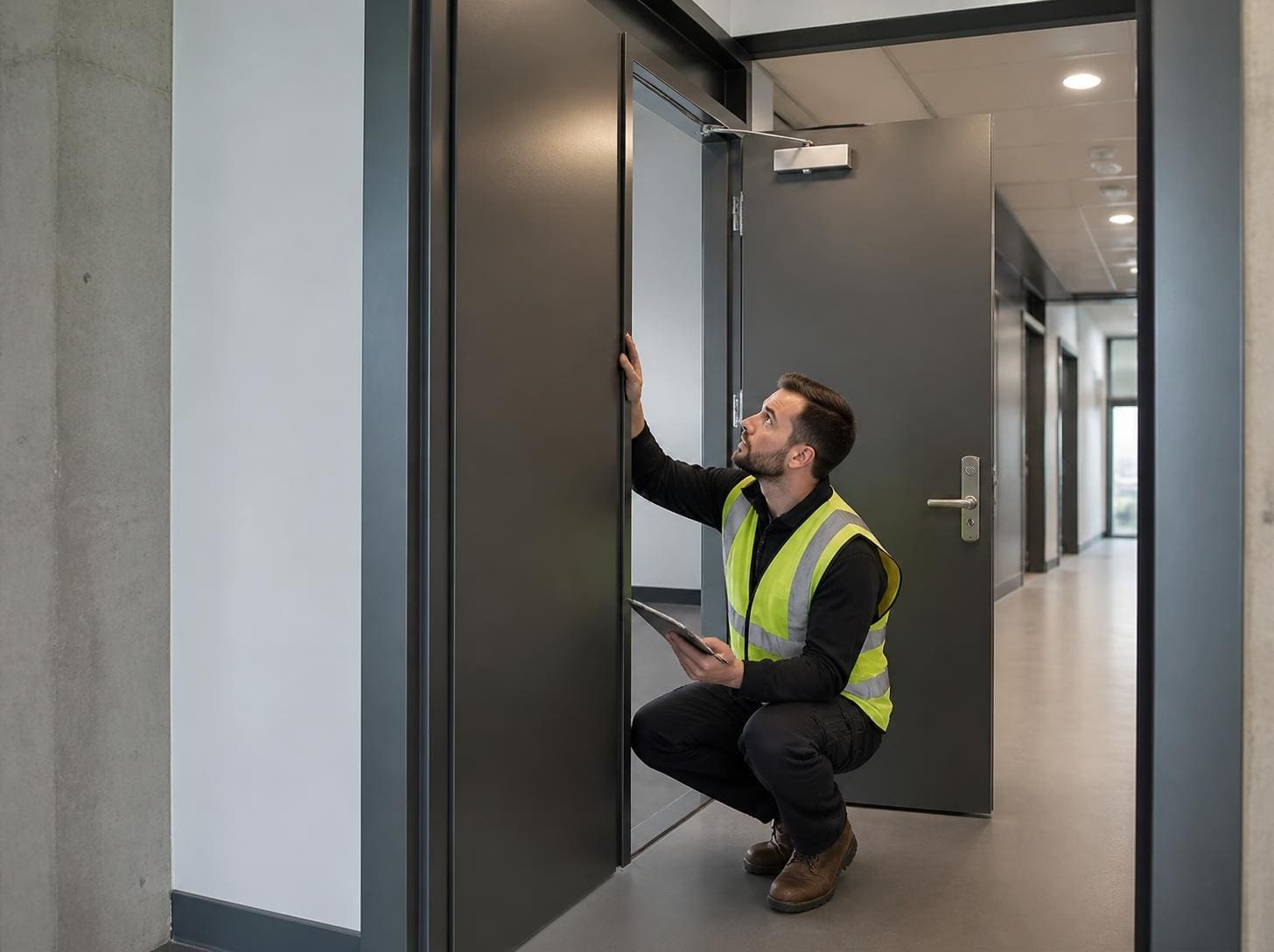
A practical inspection should identify defects that could affect the door’s ability to control fire and smoke. Major checks include:
- Does the door close fully into the frame?
- Are the hinges secure?
- Is the door closer working correctly?
- Are seals damaged or missing?
- Is the glazing suitable and undamaged?
- Are there large gaps around the door?
- Has the door been altered without suitable evidence?
- Is the door being wedged or propped open?
Government guidance notes that the gap between the door and frame should not generally exceed 4mm at the head and jambs, while the bottom gap should be as small as practicable without causing the door to catch on the floor.
An inspection should also be recorded. This creates a clear trail of identified defects, recommended actions, and completed remedial work.
Fire Safety Compliance and Common Problems
Good fire safety compliance is not only about installing the correct product. A suitable door can become defective through everyday use, poor repairs, or unauthorised alterations. Common problems include:
- Loose or damaged hinges
- Faulty door closers
- Damaged seals
- Excessive gaps
- Damaged door leaves
- Incorrect hardware
- Damaged glazing
- Doors being held open
- Poor previous repair work
Government guidance advises that fire doors should be kept in good working order and repaired where appropriate. An existing door does not automatically need replacing simply because it does not meet the latest standard for a new door, provided it remains adequate from a fire safety perspective.
Fire Door Maintenance: When Should Repairs Be Considered?
The role of fire door maintenance is to identify minor faults before they develop into more serious issues. Repairs may include:
- Adjusting or replacing a door closer
- Repairing suitable hardware
- Replacing damaged seals where appropriate
- Addressing problems with hinges
- Correcting suitable installation defects
- Repairing damage where the doorset can safely be restored
Replacement may be needed where the door is beyond suitable repair, has been incorrectly altered, or does not provide the required protection for its location. Any repair should take account of the original doorset specification and the compatibility of replacement components. Third-party certification can also provide useful evidence about the product and its tested configuration.
How to Stay Compliant With Fire Door Duties
A practical approach can make fire door management easier. Those responsible for buildings and facilities should:
- Identify all fire doors.
- Understand the purpose of fire doors within the building’s fire plan.
- Incorporate these doors within the fire risk assessment.
- Inspect the doors appropriately.
- Record defects and recommendations.
- Prioritise serious defects for action.
- Use competent professionals for specialist inspection, repair, or replacement.
- Keep inspection and remedial records.
It is also important to avoid treating an inspection as a one-off exercise. Fire doors are used every day and can deteriorate through normal wear and tear.
Conclusion
Fire door regulations are an essential component of proper building management. Fire doors must be installed and maintained appropriately to perform their intended function. Griol Fire Protection delivers fire door inspection, maintenance, installation, repair, and fire safety compliance services in London and Greater London. The company provides a complete service, including professional inspection, reporting, and guidance.
Frequently Asked Questions
1. Do all buildings need fire doors?
Not every door in every building needs to be a fire door. This depends on factors such as the building’s structure, design, and intended use. Compartmentation, escape routes, and the fire risk assessment also need to be considered. Where fire doors are required, the doorset should be suitable for its location and intended performance.
2. How often should fire doors be inspected?
There is no single inspection interval that applies to every building. In England, specific rules apply to certain multi-occupied residential buildings over 11 metres. These require communal fire doors to be checked at least every three months and flat entrance doors at least every 12 months on a best-endeavours basis.
3. Does a damaged fire door always need replacing?
No. Some defects can be repaired if the doorset can be safely restored to an appropriate condition. A professional assessment can help determine whether the door needs to be repaired or replaced.
4. Can I replace fire door hardware myself?
Care should be taken with any alteration. Hinges, closers, locks, seals, and other components need to be compatible with the doorset. Incorrect components or alterations can affect fire performance. Where there is uncertainty, it is advisable to use a competent fire door professional.
5. What happens if fire doors fail an inspection?
It is important that faults are documented and assessed. Problems that require urgent attention should be addressed promptly. Depending on the defect, adjustment, repair, replacement of a component, or replacement of the affected doorset may be necessary.