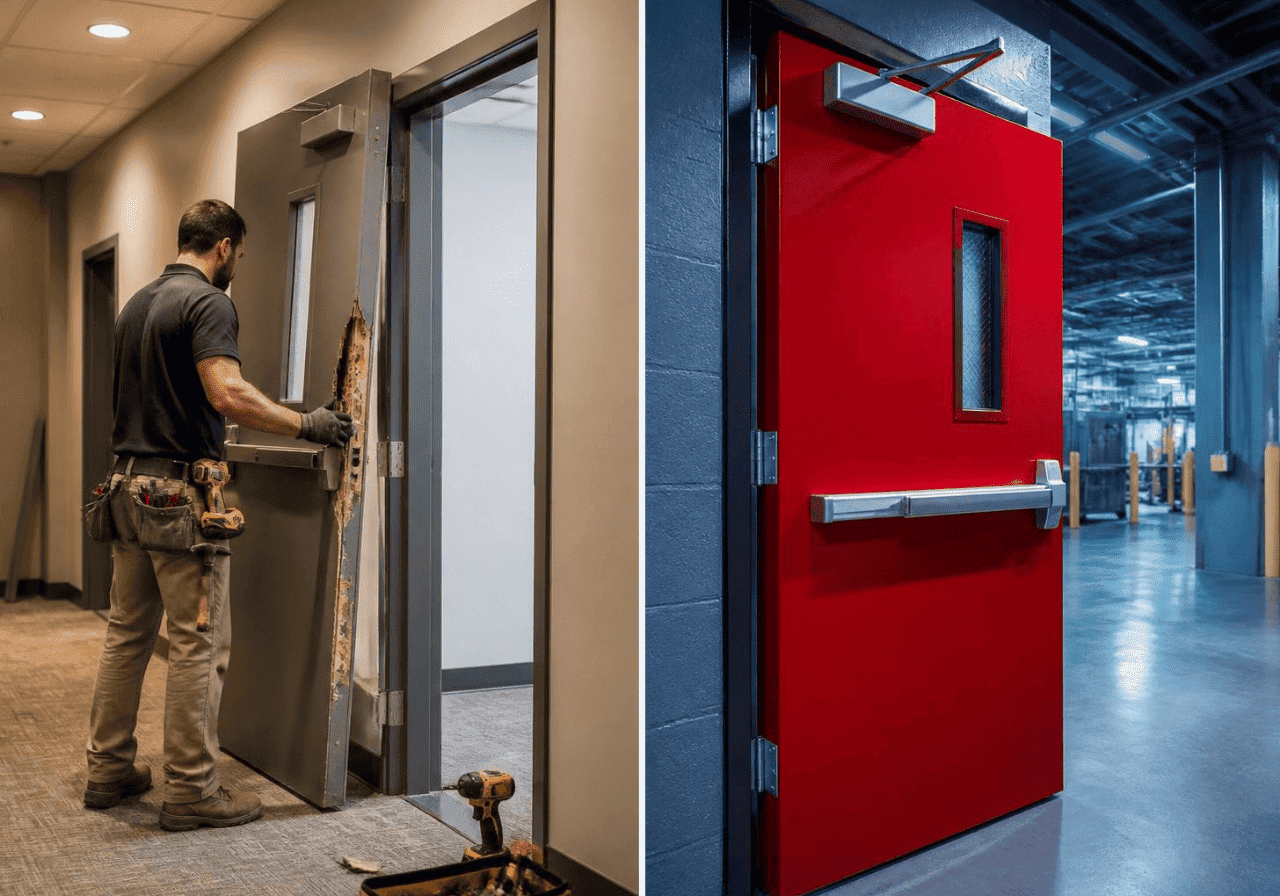
Fire doors are an important part of a building’s fire protection system. They are useful in preventing fires from spreading from one compartment to another. Thus, this gives occupants more time to escape. Problems with the door leaf, frame, seals, hinges, glazing, or closing device can affect how well the complete doorset performs. This is where fire door replacement can become necessary.
Replacing a door is not always the first solution. Some defects can be repaired. But when it’s not repairable, replacing it is a better option in order to achieve safety standards. But replacement should not be based on appearance alone. A professional inspection can determine whether a door needs repair, maintenance, or complete replacement.
Why Fire Doors Matter to Building Safety
Fire doors have been made in such a way that they assist in containing fire and smoke for a certain duration of time, when installed and used properly.
Some of the practical benefits of a well-functioning fire door include:
- Reduce smoke spread.
- Help protect corridors, stairways and other escape routes.
- Support the building’s fire compartmentation.
- Give occupants more time to leave safely.
- Help responsible persons manage their fire safety duties.
The UK Government describes fire doors as one of the important measures used to safeguard means of escape. It also states that doors should be kept in good working order and repaired or replaced where defects affect their ability to resist fire and smoke spread.
When Should a Fire Door Be Replaced?
Not every damaged door needs to be removed. A professional inspection should first establish whether the problem can be safely repaired.
Replacement may be considered when:
- The door leaf has serious damage.
- The door has been extensively modified.
- Previous alterations have affected the doorset’s performance.
- The door fails to close properly.
- Important components cannot be repaired appropriately.
- The door is unsuitable for its location or required fire performance.
- The complete doorset cannot be restored through suitable remedial work.
The condition of the complete doorset matters. A door leaf may look acceptable while the frame, seals, or closing device has serious defects. This is why an inspection should look beyond the visible surface before a replacement decision is made.
How Fire Door Replacement Improves Fire Safety
The main benefit of replacing a defective door is restoring the performance of the fire protection system. A new, correctly specified and installed doorset can address defects that cannot be resolved through repair.
1. It helps restore compartmentation
Fire doors form part of the barriers that separate areas within a building. If a door is badly damaged or does not close correctly, fire and smoke may move through the opening more easily.
2. It improves door closing performance
A fire door needs to close properly. A damaged door may catch on the frame, have excessive gaps, or fail to operate with its self-closing device. A correctly installed replacement should be selected and fitted as a complete system suitable for its location.
3. It supports safer escape routes
Fire doors in hallways, staircases, and other common spaces could restrict the spread of fire and smoke. This is particularly important in buildings where many people share the same escape routes.
Replacement Fire Front Doors for Flats
Flat entrance doors need particular attention because they separate individual homes from shared areas. For buildings in England covered by the Fire Safety (England) Regulations 2022, responsible persons must use best endeavours to check flat entrance fire doors at least every 12 months where the building’s top storey is more than 11 metres above ground level. Communal fire doors in these buildings require checks at least every three months.
The checks focus on issues such as:
- Whether the door closes properly.
- Damage to the door or frame.
- Problems with hinges and hardware.
- Damaged glazing.
- Problems with seals where fitted.
- Excessive gaps.
- Issues with the self-closing device.
Replacement fire front doors for flats should therefore be considered when an existing entrance door cannot be safely restored through suitable repair. Importantly, government guidance says that an existing flat entrance door does not automatically need replacement simply because it does not meet the current standard for new-build doors. The decision should consider the fire risk assessment and the actual condition and performance of the existing door.
Fire Door Replacement and Maintenance Work Together
Replacement should not be viewed as a one-off answer to fire door safety. New doors also need regular checks and maintenance. Hinges can loosen. Closers can become damaged. Seals can deteriorate. Doors can also be altered or damaged through everyday use.
Better fire door replacement and maintenance planning should therefore include:
- Checking doors regularly.
- Identifying defects early.
- Repairing suitable faults.
What Affects Fire Door Replacement Cost?
The fire door replacement cost can vary greatly from one property to another.
There is no standard fee that is charged for all jobs. The final quote may be determined by:
- Fire resistance requirements.
- Door size and specification.
- Type of door and frame.
- Hardware requirements.
- Glazing requirements.
- Condition of the existing opening.
- Labour and installation requirements.
- Number of doors being replaced.
- Access to the property.
- Removal and disposal of the old doorset.
- Certification and documentation.
Current UK cost guides show that installed prices can range widely depending on the door specification and complexity of the work. Standard internal doors can cost considerably less than specialist commercial, glazed, steel or flat entrance doors. For this reason, buyers should compare the scope of each quotation rather than choosing a contractor based only on the lowest price.
What to Look For in Fire Door Replacement Services
Choosing the right contractor is an important part of the process. Look for fire door replacement services that include more than simply fitting a new door.
A suitable service should consider:
- Inspection of the existing doorset.
- Correct door specification.
- Clear documentation.
- Photographic evidence where appropriate.
- Advice on future maintenance.
The contractor should also explain why replacement is needed. This gives property owners, landlords, facilities teams and managing agents a clearer basis for approving the work.
Choosing the Right Doors for Commercial Buildings
Different buildings have different fire safety requirements. Offices, schools, healthcare buildings, hotels, housing blocks and industrial properties may all use different types of fire doors. Commercial fire doors should be selected according to the building’s requirements and the location where the door will be installed. The complete door set matters. The door leaf, frame, seals, glazing, hinges, closer, and other hardware need to work together.
Final Thoughts
A damaged or unsuitable fire door should not be ignored. The right solution may be repair, maintenance or complete replacement, depending on the condition of the door set and the findings of the fire safety assessment. Griol Fire Protection provides fire door inspection, repair, maintenance, installation and replacement support for residential and commercial properties across Greater London and the Home Counties.
Its services include detailed inspections, digital reports, photographs and practical recommendations to help property teams understand what needs attention. If your building has damaged, ageing, or failed fire doors, Griol Fire Protection can assess the condition and help you plan the appropriate next step. This provides a practical route from inspection to remedial work while keeping fire safety at the center of the project.
Frequently Asked Questions
1. How do I know if a fire door needs replacing?
A fire door may require replacement when serious damage, poor alterations, or other problems have made its safe repair impossible. An inspection should assess the complete door set before replacement is recommended.
2. Do all flat entrance doors need to be replaced?
No. An existing flat entrance door does not automatically need replacement simply because it does not meet the latest standard for new doors. Its condition and performance should be considered as part of the building’s fire risk assessment.
3. How much does a new fire door cost?
The prices differ depending on the door, the fire resistance rating, and the frame. The type of hardware, its fitting, and the process of installing it will also play a role. In the quotation, the item that is being quoted should be explained explicitly rather than giving just the price of the door.
4. Who should carry out fire door replacement?
Replacement should be completed by a competent contractor with suitable knowledge and experience of fire doors. The work should include appropriate specification, installation, and records.